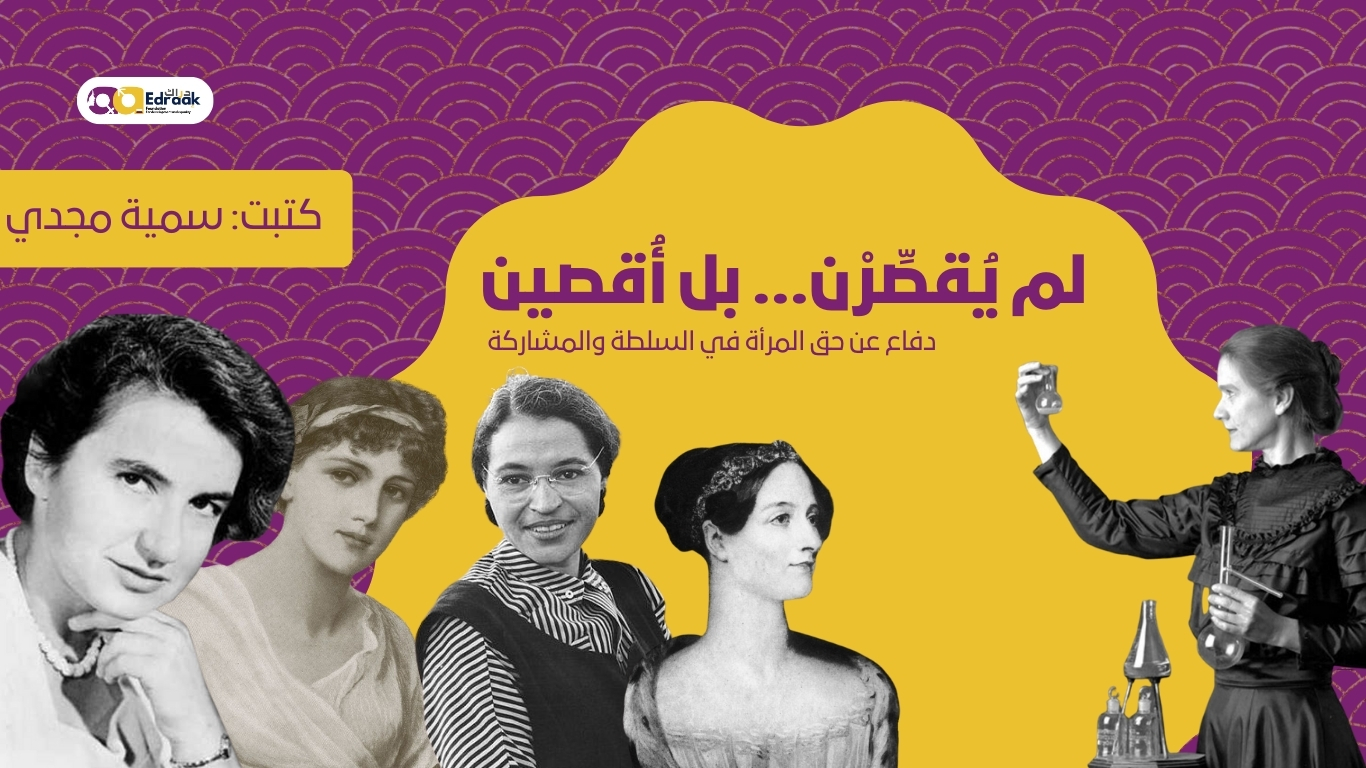
The renewed debate surrounding the appointment of Egyptian women to leadership roles within Egypt’s House of Representatives has once again stirred familiar questions about women’s legitimacy in holding positions of power, their standing in society, and the persistent attempt to tie that legitimacy to selective readings of women’s “historical achievements.” Such arguments are often used to imply an inherent deficiency in women’s capacities as a sex thereby justifying the withdrawal of their most basic rights. Yet the debate, as it is currently framed, is built on clear fallacies. It is neither coherent nor evidence-based; rather, it seeks to distort reality. This text aims to dismantle those assumptions carefully, in order to foreground the facts and to restore a truthful picture of women’s capabilities and their place in society.
Maternal death was not a “natural condition” it was a consequence of neglect
From the beginning of the twentieth century through its mid-point, maternal mortality during pregnancy and childbirth was extremely high worldwide even in countries with relatively strong resources because obstetrics and maternal care were still underdeveloped, and regular, specialized healthcare services were not available to women at scale. In that era, the risk of death in childbirth was treated as an ordinary feature of women’s lives, in the absence of preventive plans and advanced medical interventions of the kind we now consider standard.
With medical progress in the second half of the twentieth century starting with the discovery of antibiotics and the development of institutional maternal care maternal deaths declined dramatically across the world. This shift makes one central point unmistakable: the availability of specialized healthcare saves lives, year after year, particularly for women who were finally able to experience childbearing as part of a normal life course, rather than as a recurring encounter with imminent death.
What the numbers tell us: progress, but not equality
According to UNICEF data, global deaths related to pregnancy and childbirth declined by approximately 40% between 2000 and 2023 from around 328 to 197 deaths per 100,000 live births largely due to the expansion of healthcare services and improvements in the quality of care before and after birth.
Despite this progress, the gap between lower- and higher-income countries remains stark. In low-income countries, maternal mortality reaches about 346 deaths per 100,000 live births, compared to only 10 per 100,000 in high-income countries. This disparity reveals a profound inequality in women’s chances of survival and in their ability to fulfill reproductive roles alongside other roles in education, work, and public life.
How does this connect to reproductive roles and women’s status in society?
The long history of high maternal mortality and inadequate healthcare reflects, in part, the traditional social positioning of women where women were often viewed first and foremost as reproductive caregivers: a “source of births,” rather than a full human being with rights and freedoms. In that period and still today in many societies pregnancy and repeated childbearing are treated as a core expectation placed upon women. This expectation frequently pulls girls out of education and employment and pushes them into narrowly domestic roles.
The social assumption that a woman’s primary function is childbirth and family care not education or work has historically contributed to depriving girls of adequate schooling and appropriate healthcare. This, in turn, increased health risks, restricted life opportunities, and weakened women’s participation in economic and political life.
Today, in many low-income settings, child marriage and girls’ withdrawal from school under pressure of early marriage and early childbearing remain widespread reflecting the continued dominance of social norms over women’s ability to shape their futures, rather than enabling their full participation in society based on their capabilities.
Education and early marriage: a social lens with layered impacts
One of the most significant obstacles women face is not their capacity, but the social expectations and predefined roles imposed on them from childhood. From an early age, girls in many societies are raised around ideals of appearance and obedience, and are socialized into the notion that their future is confined to marriage and family care. These early gender templates limit girls’ educational opportunities, weaken their ability to make independent decisions, and normalize a society that demands women conform to narrowly defined roles.
The effects extend into working life. The more a girl learns and completes her education, the more her chances increase to exercise her right to work and to participate politically. Conversely, the absence of education or the dominance of traditional templates constrains choices, pushing girls into predetermined pathways such as early marriage or full dependency.
Reality shows that in low-income countries, or in societies that fail to provide women with comprehensive education and health protection, these social templates continue to reproduce constraints on women’s participation even alongside medical progress and modern schooling. The challenge, therefore, is not only enabling women to reach positions of authority, but also dismantling stereotypes from childhood and ensuring equal educational and health opportunities.
All of this results in women’s participation in public life whether in the labour market, political life, or community decision-making being far lower than it should be, not because of “fate,” and not because women are inherently unqualified as some claim, but because the social system did not provide equal opportunities from the outset.
Rights and equality are not granted based on “historical achievements”
Equality in rights is not bestowed on the basis of historical accomplishments, numbers of inventions, or the accumulation of awards. It is an inherent entitlement that belongs to every human being at birth, regardless of sex or background.
Linking women’s political participation and their access to leadership roles to “proof” in the form of historical achievements or comparing the number of scientists between men and women, or between peoples is a logical fallacy used to justify exclusion. Basic rights such as education, health, work, and political representation are not privileges to be earned; they are rights that must be guaranteed equally to every citizen, from the moment of birth.