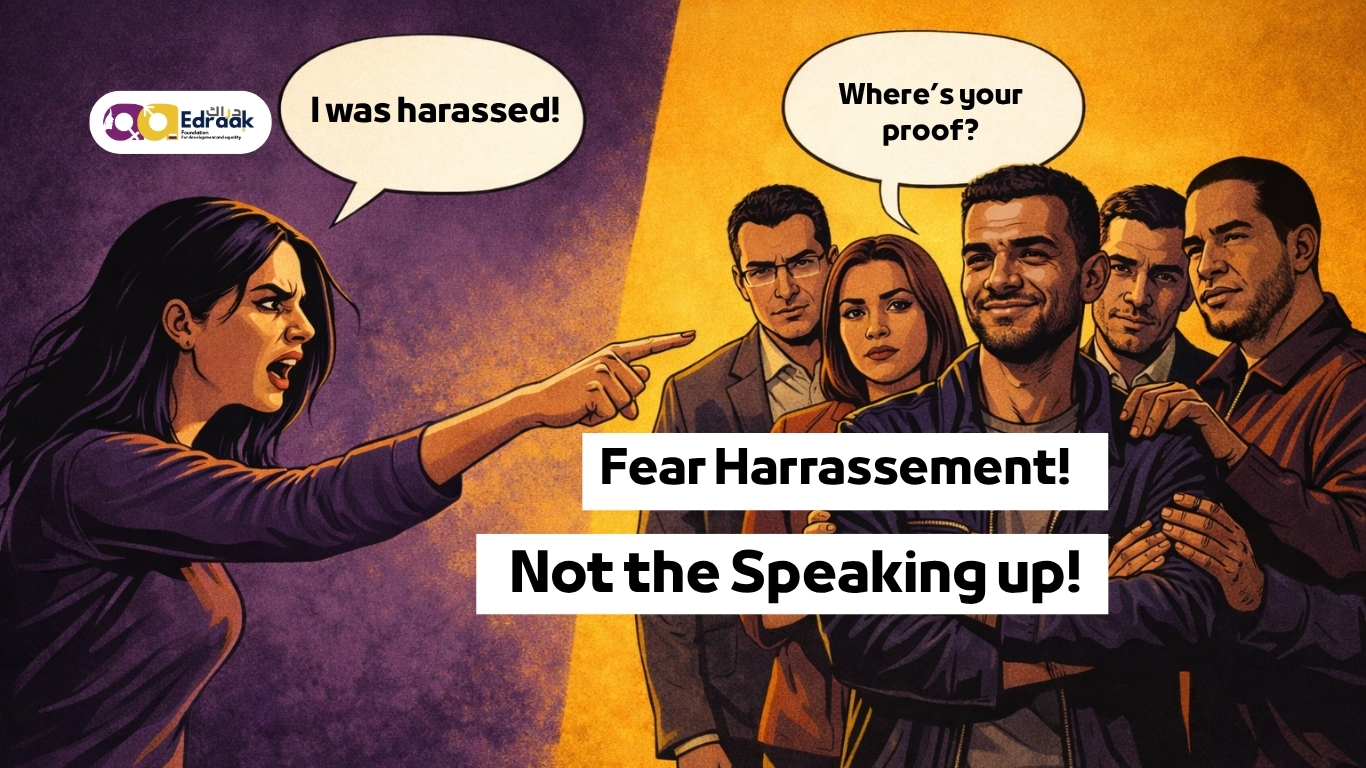
Every time a woman comes forward and says, “He sexually harassed me,” the first question often asked is: “Are we supposed to believe her without evidence?”
At first glance, this may seem like a reasonable question. Any allegation should be subject to scrutiny. Justice requires evidence and due process, and the principle that a person is innocent until proven guilty remains fundamental. The problem, however, is that this question is often raised in isolation from the reality of how sexual harassment actually occurs. It is treated as though it concerned a clear, material crime with witnesses and tangible traces, when in fact harassment rarely takes that form.
Sexual harassment is not like theft, where something visible has been taken, nor is it a crime that always leaves medically documented evidence. It often happens in concealment: in the dark, in crowded public spaces, on public transport, behind closed office doors, in moments of abuse of authority, or within relationships marked by clear imbalances of power. It may happen in seconds, sometimes with no witnesses at all, and sometimes in front of witnesses who choose to look away. Its very nature is that it often occurs in secrecy. To demand that a survivor immediately produce proof is therefore to impose a second burden on top of the harm itself: the burden of proving what was designed to leave little trace.
The reporting gap and the myth of widespread false accusations
A statistical analysis published in 2012 compiled data from multiple sources to compare public fears of false accusations with the actual barriers surrounding the reporting of rape and sexual assault.
What the data consistently show is not an epidemic of false reporting, but a profound crisis of underreporting. Some estimates cited in the study suggest that reporting rates may not exceed 10% in certain contexts, meaning that approximately 90 out of every 100 incidents never reach law enforcement at all. Other studies place non-reporting rates between 75% and 95%. While figures vary across studies and settings, the consistent finding is that a vast proportion of sexual violence never enters the criminal justice system in the first place.
Why does this happen? Because reporting is not a simple act. In practice, it often means that a woman must submit to invasive questioning about the details of her body, her choices, and her private life. She may be asked what she was wearing, where she was, why she went there, why she was out at that hour, why she did not resist, why she remained silent, or why she is speaking now. It means entering a long and exhausting process that may still end without accountability: the case may be dismissed, closed, or result in acquittal for lack of sufficient evidence. In some cases, reporting also exposes women to very real risks of retaliation, especially when the perpetrator holds social, professional, or institutional power.
By contrast, the most methodologically rigorous estimates, including research cited by the National District Attorneys Association (NDAA), place false reports within a range of 2% to 8% of reports made to the police. Two clarifications are essential here. First, this percentage refers only to cases that were formally reported, not to the full number of incidents that occurred. Second, a false report is not the same as a case that did not end in conviction. The absence of a conviction does not mean the absence of a crime. Evidence may be insufficient, witness testimony may conflict, a survivor may withdraw under pressure, or institutional processes may themselves be flawed.
When these realities are placed side by side, the imbalance becomes clear. Public discourse often magnifies the small statistical possibility of false accusation while minimizing the overwhelming scale of abuse that remains undisclosed, unreported, or unaddressed.
What does it mean to “believe survivors”?
When we say Believe Survivors, we are not calling for the abandonment of justice, nor are we arguing that allegations should replace investigation. Rather, we are calling for a shift in the starting point. Instead of beginning with automatic suspicion, we begin with serious, good-faith listening.
Believing survivors means refusing to treat dishonesty as the default assumption. It means recognizing that women who come forward often do so with full awareness of the costs they may pay: damage to reputation, strained family and social relationships, professional consequences, online abuse, and pressure from both the perpetrator’s community and their own. In many societies, a woman who speaks about sexual violence knows that her private life, dignity, and credibility may be placed under harsher scrutiny than the conduct of the person she accuses.
To acknowledge this reality is not to suspend standards of proof. It is simply to understand that speaking out is rarely easy, socially rewarded, or risk-free. The claim that accusations are an easy instrument of revenge ignores the immense social and psychological cost that many women bear when they choose to speak.
Justice requires evidence, but society chooses where to place its doubt
Criminal justice must continue to rely on investigation, evidence, and rigorous procedural standards. This is a basic right owed to any accused person. But the public conversation is broader than the courtroom. It is also about whose pain we minimize, whose fear we amplify, and whose voice we treat as credible from the outset.
When society is more afraid of false accusations than of harassment itself, it sends a devastating message to survivors: if you speak, your first battle will not be against the violence you endured, but against the assumption that you are lying.
We need to recalibrate our moral compass. A society that begins with mockery, doubt, or suspicion makes it harder for survivors to come forward. A society that listens seriously while preserving the demands of justice helps narrow the enormous gap between the scale of sexual violence and the small fraction of cases that are ever reported.
Fear harassment, not disclosure. Because the data, even with all the limitations inherent in social research, do not point to a flood of false accusations. They point instead to a vast ocean of violations that remain unheard, unreported, and unaddressed.